YCC webinar on media
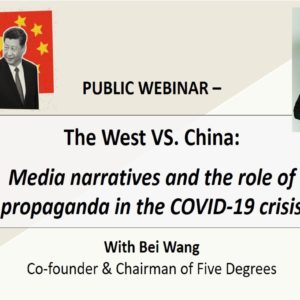
The West vs China: Media narratives and the role of propaganda in the COVID-19 crisis
On June 25th, Young China Circle hosted its first ever webinar. For the inaugural webinar, YCC invited Bei Wang. As a self-proclaimed activist at heart, Bei Wang currently is the co-founder and Chairman of Five Degrees. Five Degrees is an organisation that aims to connect the EU/Europe and the US with China. For almost two decades, Five Degrees has helped Western organisations and companies tell their stories, promote their brands and sell their products and services to the Chinese. Before starting her own company, Bei worked in Dutch media for more than 10 years.
Globalization and media
Since the start of globalization, technology has sped up and media has become a rapid-fire of mass (dis)information. There are many advantages to globalization, we are able to communicate more effectively and efficiently with people all over the world and social media allows us to stay in touch with different cultures. International media can make us more aware of what is happening on the other side of the world. But the spread of mass media all over the world has not been without its challenges. Globalization is expensive and it is highlighting the gap between the haves and the have-nots. Most terrifyingly, countries under authoritarian rule have seen an increase in the restriction of freedom of press. This happens increasingly as “liberal” or “western” media can propagate their own ideas and views. The 24-hour cycle of media has made us incapacitated in the amount of information we are able to consume and process.
Five lenses for media
In effect, as someone who is trilingual, Bei derives her own form of sport; setting up games to see how different media portray similar events. In her webinar, Bei challenges us to do the same.
Take a look at these headlines and try to derive its source;
- Why it’s time to re-roll the US-China relationship
- A new history of being Asian-American
- China battles to control nationalist narrative on social media
- China is mobilizing its global media machine in the coronavirus war of words
When looking at these four headlines, Bei tells us that it is important to keep in mind 5 lenses. Much like her organisation Five Degrees, Bei jokes that she likes to count in 5s. Who owns the newspaper in which a publication has appeared, what is its ownership? Is it a Chinese state-owned newspaper company or is it owned by an American conglomerate. Next, it is important to consider sources. Who is quoted in the article? Do those quoted have degrees in their respective fields?
Third, take a look at perspectives. Does the author consider both sides of a dilemma? Fourth, what does that author use as their narrative. Is it an op-ed or a commentary, or does the article merely state facts. A last consideration is nuance. This consideration can be the most difficult – what does the author try to imply in her/his article? Is she/he trying to make a point? Is their point overt and transparent, or is it implicit?
Bei ends her webinar with an interesting think piece – and some homework. Recently, on the 22nd of June, the EU-China summit took place via video conference. Using the tools Bei has provided us with (5 lenses to analyse media), we can now come up with our own views. Much like a diet, Bei suggests we can become more mindful of what we consume.
YCC would like to thank Bei for her interesting input, and we hope to see you at our next seminar/webinar!
Find Bei Wang:
www.beiwang.nl (personal website)
www.five-degrees.com (company website)
Mail: bei@five-degrees.com
- This article appeared on Sixth Tone and is written by Josef Gregory Mahoney, a Professor of Politics at East China Normal University. Sixth Tone is an online magazine owned by the Shanghai United Media Group, a state-owned enterprise.
https://www.sixthtone.com/news/1005385/why-its-time-to-re-roll-the-u.s.-china-relationship - A cultural comment appeared in The New Yorker by Hua Hsu. Most readers of the New Yorker hold “consistently liberal” political views according to Pew Research. https://www.newyorker.com/culture/cultural-comment/a-new-history-of-being-asian-american
- This article appeared in the SCMP and is written by Kinling Lo. SCMP is a Hong Kong English-language newspaper and Hong Kong’s newspaper of record, currently owned by Alibaba Group. Before it was owned by Rupert Murdoch’s News Corporation. https://www.scmp.com/news/china/diplomacy/article/3086698/china-battles-control-nationalist-narrative-social-media
- An article by Hadas Gold and appeared in CNN Business. CNN is owned by America’s conglomerate AT&T. Upon its launch in 1980, CNN was the first television channel to provide 24-hour news coverage.
https://edition.cnn.com/2020/05/15/media/china-coronavirus-global-media/index.html
New: Young China Circle
‘How do Dutch millennials view China’s rise?’
That was the central question of the China College Tour this spring. After lively discussions at universities all over the Netherlands, we presented the outcomes of the China College Tour to the Dutch Ministry of Foreign Affairs on April 10.
Interactive and personal
At the interactive sessions, co-organised by Krijger & Partners, universities and student organisations and supported by the Ministry of Foreign Affairs, we discussed issues such as:
– The two faces of China: techno-economic genius or command and control system?
– Understanding the giant: culture, politics and the innovative economy in China.
The personal experiences presented by students of Netherlands-Asia Honours Summer School were especially insightful. In addition, there were keynotes by Kathleen Ferrier, Xiaojia Xu, Ties Dams, Friso Stevens, Michiel Ebbing, Rene Cuperus and Ardi Bouwers. Their presentations formed the basis for questions and discussion.
Lack of knowledge
The most important overall conclusion was that millennials are very curious about what’s happening in China, but find they lack in-depth knowledge of that rapidly changing country. History lessons that focus on Europe and the western world, for example, tend to create a fear of China, instead of arousing curiosity (as a Dutch saying goes: ‘Unknown makes unloved’). Participating students were adament that both in secondary and higher education, more attention should be paid to China to fill this knowledge gap.
Curious, but critical
The China-debate should be broad, they say, and focus on values (both Dutch/European and Chinese), trade, innovation, climate, sustainability, privacy and cyber-security. So let’s not narrow it down to a struggle between merchant (‘koopman’) and preacher (‘dominee’). The conclusion? The millennial generation will face the challenge of a rising China and they want to adopt a curious, but critical attitude.
Krijger & Partners and China Circle decided to establish Young China Circle, a platform that wants to continue the China debate and secure the highly necessary input of millennials. All contributors to the China College Tour will be actively involved in this initiative.
Do you have a question or request for Young China Circle?
Please contact: tom@krijgerandpartners.com or ardi@chinacircle.nl
Stay tuned for new ideas, sessions and exchanges!
About Young China Circle
Young China Circle is a community of students and young professionals with a strong interest and/or connection to China. YCC is a platform for discussion, networking and knowledge exchange on current and topical developments surrounding China.
Contact
Join and follow our community!
E young@chinacircle.nl
About China Circle
China Circle is specialized in strategy, intercultural communication, storytelling and media. China Circle provides public keynote speeches, private strategic sessions and interactive trainings to organisations focusing on interchanges between China and Europe.
Contact
M +31 6 2323 4404
E ardi@chinacircle.nl